


Post-Processing Analysis pt.6 - Survey Set-up & Results

Research Summary
This research explores post-processing in stylized 3D horror video games and which post-processing methods are most effective in creating an 'eerie' mood.
Now that all three post-processing styles are complete, the next step is to send out a survey to gather responses. Previously, I had hoped to further develop the eeriness of the three post-process styles after evaluating the survey responses, as well as test two different lighting settings for each post-process style. Due to the time constraints of this research project, the post-process styles will not undergo further development. This final blog post will showcase the final product, explain the decisions made in forming the survey questions, discuss the responses received through survey, and how these findings answer my research question.
A quick note:
In the previous blog posts, I used the term 'unease' instead of 'eeriness' and 'emotion' instead of 'mood'. I changed these terms to better reflect the research and to ensure consistency in the terminology. The term 'emotion' is misleading, as 'eeriness' is a mood or quality of being, rather than an emotion. Additionally, the mood these post-processing styles invoke is the metric I am measuring, not the subsequent emotions. Within that same line of thought, the term 'unease' is misleading as it refers to an emotion rather than a visual mood. Although the terms 'mood' and 'emotion' can be used interchangeably, within the context of this research 'mood' refers to the visual impression the post-process scenes have on the viewers. In other words, "A distinctive atmosphere or context." (Merriam Webster Dictionary, 2026).
For those reasons, the research title was re-worded to be: "Achieving Eeriness Through Stylized Post-Processing", and the research question was changed to: “What are the most effective methods to achieve an eerie mood using stylized 3D post-processing?”
The Final Product
For the purpose of the survey, the Unreal Engine project starts on a title screen which gives users the option to view each post-process style individually.
The final post-process styles are shown in the images below, and the GIFs can be viewed through this link.


Formatting the Survey
The survey was sent out to game development students at Media Design School in Auckland, New Zealand, as well as a couple non-students unfamiliar with game development but experienced in playing video games. The survey contains three sections, one for each post-process style. Each section includes the same four questions.
In order to get as many responses as possible, I gave participants the option to either download a build of the Unreal Engine project, or preview the post-process styles through an animated GIF file embedded in the survey. This was because I wanted to gather as many responses as possible, and I felt people would be less likely to do the survey if they had to download the build. Although the link to download is included at the beginning of the survey, it does create extra steps which makes the survey take longer to complete.
In order to know which method the responders chose, I included a two choice question (Q1) at the start of the survey asking whether surveyees based their responses off the build or the GIFs provided. This was to see whether experiencing the post-process styles through the project or the GIFs affected the responses.
I also gave the option to review one, two, or all three post-process styles - and in any order. This was to avoid responses becoming shorter by the time surveyees reached the last section, potentially effecting the quality of the responses for the last post-process style shown.
Survey Questions
All three sections start by displaying a GIF of the post-process style, then followed by the following four questions.
Q2

This question is to see how eerie the participants found each post-process style. To maximize participants understanding of the question, the term 'eerie' was defined in the description. Originally, I referenced a fear scale from a paper by Ntokos, Konstantinos (Ntokos K, 2018), which ranged from Calmness (1) to Panic (10). I decided to change this question to provide responses that would better support the research. I am measuring eeriness, not fear. As mentioned earlier, the metric here is the perceived visual mood/quality of the post-processing rather than the emotion it causes. It is likely participants would have selected low fear responses to the given GIFs or playthrough of the post-process styles.
Q3

This question prompted further explanation from the participant, in hopes to find out what worked well in each post-process style and what did not.
Q4

The aim of this question was to gauge if outside aspects influenced the eeriness of the scene. Although, after gathering responses I realized a better question would be: "What contributed most to the eeriness?". This was mainly because looking at the responses in a graph, it is unclear whether the participant selected their answer due to finding the scene eerie, or not finding the scene eerie, without assessing the answers individually and making a new colour coded graph. I would also change this to single-selection options.
Q5

Similar to question three, this was to gauge why the element references in question four caused the scene to be more or less eerie. Again, after viewing the data I noticed this question requires reading through each participants individual responses to understand the full picture. Changing both question four, and this one to "Why do you think that element contributed most to the eeriness?" would have worked much better, and also potentially meant question three could be omitted.
Survey Responses & Discussion
In total, 11 individuals participated in the survey. Two participants gave responses for only one post-process style, while the rest filled out all three. Although a small sample size, I gathered insightful and sometimes unexpected responses.
Q1: Which format would you like to base your answers off of?

As expected, the majority of people opted to view the GIFs instead of the project build. Although, after viewing the responses I do not think this had much effect on the results.
Section 1 (Pixel Shader)
Q2: Visually, how 'eerie' would you rate the above scene?
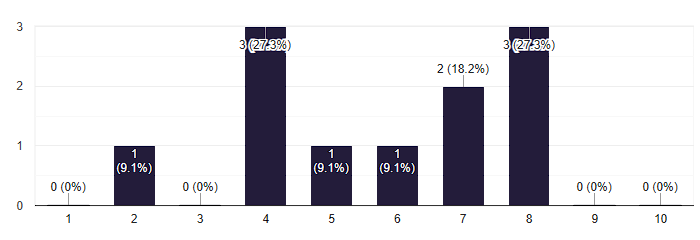
The pixel shader had a wide range, with three participants giving it a 8 while four gave it a score below 5. This shows a range of opinions. Participants who gave it a high rating mentioned elements such as the darker lighting, low-resolution, jittering, obscured vision (causing limited visual information), and the shadows contributed to the eeriness. Interestingly, the participant who gave the eeriness a 2 said the scene felt peaceful.
Q4: What contributed to your chosen emotion?

As mentioned earlier, the issue with this graph is the inability to see whether participants chose their options due to positively affecting eeriness, or taking away from it.
Interestingly, one person chose 'the textures'. This was one of the participants who was not studying game development. Therefore, they may have not realized the textures were consistent across all three post-process style. Although, this could also imply the textures added or took away from the eeriness differently across the three shaders.
The lighting may seem like the strongest contender, but the choices were actually split between answering "eerie" in question 2 (score of 6-10) vs "not eerie" (score of 1-4). The people who found it eerie said the lighting contributed to the eeriness due to the high contrast and gloominess. This would be due to the post-processing as the base lighting was kept the same across all 3 scenes.
One person mentioned the giant tree models increased the eeriness, while another said the rounded models and flowers decreased the eeriness.
To summarize, the responses for the pixel shader were very split, and depended heavily on what the individual considered eerie. It achieved eeriness most strongly through the use of harsh shadows, gloomy colours, and the obscured vision. It could improved by adding "fog", further lower saturation, and a smaller field of vision (more vignette?).
Section 2 (Toon Shader)
Q2: Visually, how 'eerie' would you rate the above scene?

The toon shader received a low range on the eeriness scale, with three participants giving it a score of 1.
Although, four people gave it a score over 5. People who gave it a low rating mentioned the tones being too warm and that the cartoon look - especially the shadows - made the scene less eerie. It was also noted to be easier to navigate than the others. Although, some people mentioned the cartoon style, harsh shadows, and almost nostalgic look actually contributed to the eeriness, and made it somewhat uncanny. One person also mentioned this shader might work better if the models were less cute.
Q4: What contributed to your chosen emotion?

The shader, lighting, and textures affected the eeriness the most (either positively or negatively). Again, I am assuming the participants are referencing the post-processing styles' effect on the textures appearance. Quite a number of people who chose lighting said the scene was not very eerie, while the shader was more even.
The toon shader got the most results for the models compared to the other two, which like the textures, was probably the participants referencing the post-processing styles' effect on the models.
One people mentioned the lack of sound contributed to the scariness. I intentionally left the project soundless to try and avoid sound affecting the eeriness. I do not think this swayed the results much as this was only mentioned once.
Section 3 (Hatching Shader)
Q2: Visually, how 'eerie' would you rate the above scene?

The hatching shader also had a wide range of results. People who gave it a high rating mentioned the obscured view, lack of colour, and contrast of both the shadows and the typically 2D-associated 'pencil-style' existing on a 3D setting increased the eeriness. Some participants though, found the lack of colour and pencil style to actually decrease the eeriness as it reminded them of an illustrated book or manga. Like with the pixel shader, the obscured vision caused by the shader increased the eeriness due to making the player feel more vulnerable. One person mentioned it had potential to look like a black and white horror comic.
Q4: What contributed to your chosen emotion?

The majority of participants chose the shader. This is likely due to how intense the hatching shader is and the major effect it has on the resulting visuals. Although, about five people who ticked 'the shader' meant it in the sense that the shader decreases the eeriness. The strongest element causing eeriness of this shader was 'the textures' and 'the lighting'. 'The textures' was likely referring to the hatching textures, as the base textures were not even visible under the post-process effects.
A participant mentioned "...I feel like the shader can enhance an existing feeling of eeriness in the scene but does not define it.", also saying that the lack of movement in the scene probably contributed to the eeriness which is a factor I did not consider.
One person who gave a high eeriness score said "It kind of looks like scribbles and I associate that with confusion or disarray". Potentially using a more chaotic or squiggly texture instead of the hatching textures might create a unique eerie visual style. Although, this may cause eye-strain. A participant did mention the hatching shader was "...initially visually striking but for long sections of time would cause visual fatigue for the player."
Conclusion
The responses from this study show eeriness can be achieved in a stylized 3D setting using post-processing. Although, it depends heavily on the individuals personality and what they themselves find eerie. Additionally, other visual elements in the game largely influence how the post-processing affects the over-all setting.
The toon shader ended up doing the poorest, although one person did give it an eeriness score of 9. I wonder if it would have gotten higher ratings if it had cooler lighting and tones. The pixel shader and hatching shader were fairly even, with two people giving the hatching shader a score of 9, and three people giving the pixel shader a score of 8. Both received a 2 from one participant as their lowest score. Although the graphs did not show an obvious pattern, this was potentially due to the small sample size.
To answer my research question, this shows most effective methods to achieve an eerie mood using stylized 3D post processing are typically obstruction of view, exaggerated shadows, cool lighting, desaturated hues, and odd or jarring effects - such as contrast in style (e.g. the 2D pencil style used on 3D). I believe more research needs to be done on the toon shader, but both the pixel shader and hatching shader are valid methods that have the potential to strongly increase the eeriness of a video game scene.
References
Merriam Webster Dictionary. (2026). Mood Definition. Merriam Webster. https://www.merriam-webster.com/dictionary/mood
Ntokos, K. (2018). “LEVEL OF FEAR”: ANALYSIS OF FEAR SPECTRUM INTO A TOOL TO SUPPORT HORROR GAME DESIGN FOR IMMERSION AND FEAR. Computer Game Development and Education: An International Journal. Vol. 1, No. 1.


Comments