


Post-Processing Analysis pt.1 - Stylized 3D Horror Games

Updated: Jun 25
Research Summary
This research explores post-processing in stylized 3D horror video games and how these post-processing methods are used to create the emotion of unease. This will be done by creating an interactive level in Unreal Engine 5. The level will feature different stylized post-processing techniques across a consistent environment. The environment is kept consistent so I can accurately measure how the post-processing alone affects the mood of the game scene. This blog serves as a written account of the process taken during the creation of the interactive level. The purpose of this resource is to explore how stylization through post-processing effects can benefit horror games, and to be a resource or inspiration for game developers.
Post-processing refers to elements such as shaders – which alter how a 3D surface reacts to light information, and screen effects and overlays – such as film gain or vignette, colour grading, tone-mapping, depth of field, and lighting.
Game Analysis
Before beginning the process of creating the game scene, I wanted to analyze the different art styles used in pre-existing stylized 3D horror games and what post processing techniques potentially went into the creation of the visual style. This is to give me a list of effective post process techniques to start from, as well as explore if, why, and how these techniques support the art style in creating an unsettling experience for the player.
The criteria for choosing which games to analyze was:
3D
Horror genre
Stylized art - not photorealism
Positive reviews
This criteria was used to ensure the games were relevant to my research topic. I also chose games that varied in art style to explore a range of different methods. Horror games that do not focus on action mechanics are also a useful resource as the horror element has to rely more on the audiovisuals rather than gameplay.
Hello Neighbor


Engine: Unreal Engine 4
Genre: Stealth Horror
Steam Reviews: Very Positive
Hello Neighbor’s art style uses cartoon-like, exaggerated models, similar to how films like Coraline (Universal Pictures, 2009) use exaggerated proportions to emphasize the grotesque elements of the characters. Both the textures, which follow a PBR pipeline, and the lighting lean more towards realism. While the gameplay mechanic of being chased in Hello Neighbor
is likely the main contributor to what makes this game scary, the contrast of realistic rendering and detail against the rounded and cartoon-like models potentially creates a feeling of unease and discomfort as well.
The post-processing effects used in Hello Neighbor are likely depth of field, bloom, mood lighting, and colour grading.
Saturnalia

Engine: Unity
Genre: Survival Horror
Steam Reviews: Very Positive
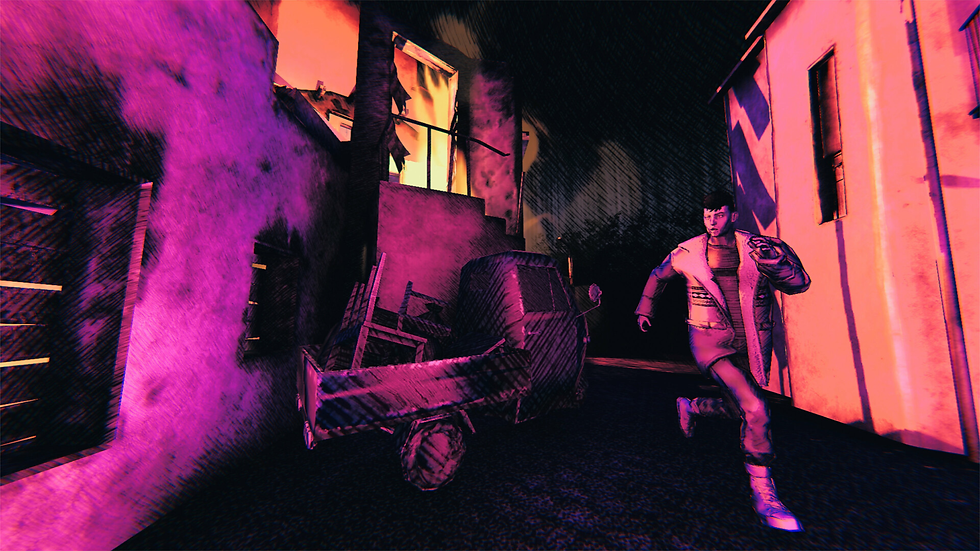
Saturnalia has a distinct and unique visual style. While the proportions of the models lean towards realism, the lighting, shading, and colour are stylized. The post-processing used in Saturnalia also supports the art style, such as the cross-hatched "pencil-scratch" shading, intense shadows, and the emphasized, mood-based lighting which changes throughout the game. The bold shading also gives the effect of black outlines on certain objects, such as the doors and windows. The increased saturation during parts of the game is especially interesting as studies have found higher brightness and saturation values in games can contribute to positive emotion. (Geslin E, et. Al, 2016).
A steam review from user xxadonisxx (with 11.1 hours spent in Saturnalia) writes:
"Visually, Saturnalia is striking and unmistakable. Its hand-drawn aesthetic, inspired by sketch art and stop-motion animation, gives the game a dreamlike, almost storybook quality that contrasts sharply with its oppressive tone. Characters move with an unnatural fluidity, and environments feel simultaneously beautiful and unsettling. Lighting, color, and shadow are used masterfully to guide the eye while maintaining a persistent sense of unease. The art style is not merely decorative; it actively supports the game’s themes of distortion, memory, and decay." (xxadonisxx, n.d).
Negative reviews on this game are mainly about bugs, the only art-related negative review mentions the inability to turn off motion blur.
Mundaun

Engine: Unity
Genre: Horror Adventure
Steam Reviews: Very Positive
Although Mundaun is a horror game with a unique art style, the hand-drawn, pencil visuals are achieved predominately in the texturing process. The post-process aspects involved here are likely the lighting, colour balance, and sharpness. Therefore, I will not try to re-create this in my project as this would require adjustment of the base models textures. However, I still plan to include a painterly/sketch-like post-processing effect in my projects based on games such as Saturnalia (Santa Ragione, 2023) and Bendy and the Ink Machine (Kindly Beast, 2017).
Birds Watching

Engine: Unknown
Genre: Psychological Horror
Steam Reviews: Very Positive
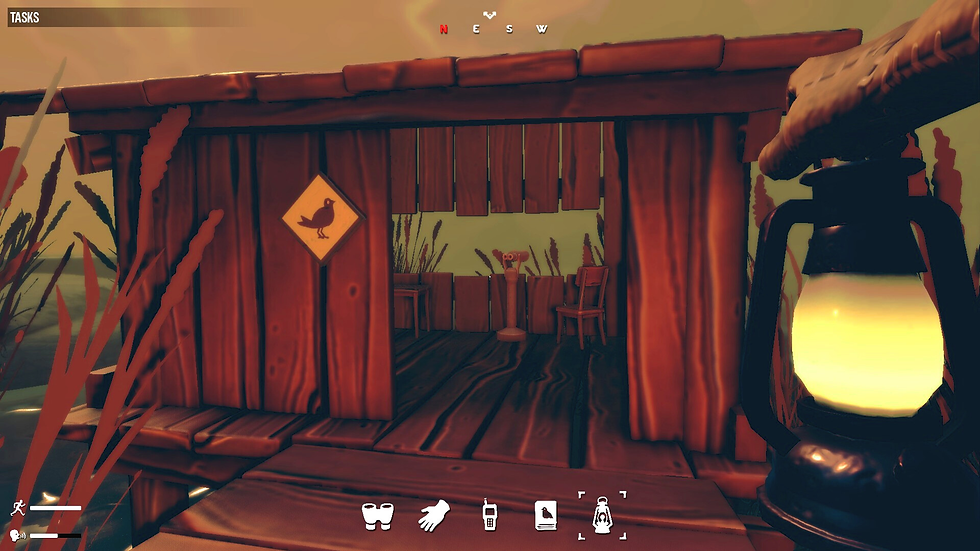
Birds Watching features a semi-realistic visual style incorporating cartoon elements in the textures with realism in lighting and proportions. Despite the cartoon-like elements, the game successfully creates an eerie and unsettling environment. The post-processing techniques enhance the over-all eeriness through the use of depth fog, colour grading, intense shadows, and both warm and cool tones.
A steam review by user rem sleep mentions how the orange, murky atmosphere adds to the eerie look of the game:
"I really enjoyed the atmosphere and vibe of the place! My first playthrough had me horribly on edge and jumping at all the little sounds. The retreat is both scenic and isolated, and the dusty orange colors over everything really do make you feel like the world is burning." (rem sleep, n.d.)
The post-processing techniques used in Birds Watching are the stylized/exaggerated lighting, colour overlays, and depth fog.
Crow Country

Engine: Unity
Genre: Survival Horror
Steam Reviews: Overwhelmingly Positive
Crow Country was published only 2 years ago yet intentionally adopts a low-poly, low-res, and 'gritty' visual style. Interestingly it is a video game art style that originates from the technological limitations of the time. It is not uncommon for modern games to intentionally recreate this look from the PS1 and PS2 era, especially horror games. This may be due to the fact that a lower-resolution results in less visibility - forcing the player to feel more vulnerable and alert, or simply as an artistic choice.
The visual style of Crow Country is a combination of realism and stylized, the environment is fairly realistic in shading and proportion while the characters have a stylized appearance similar to a doll or Lego figurine.
Steam user Tiwill mentions in their review that the stylized characters affect how scary the characters look but the game still succeeds in creating an eerie atmosphere.
"The decision to use rounded designs and chibi proportions in a survival horror game does make the game feel a bit harmless at times due to shape language. Objects with sharp, ragged edges tend to be a lot more terrifying than soft, rounded things. But I also love how the game looks. It suits the theme park vibe; it's not supposed to be a terrifying place by itself, rather it is spooky because of the events that caused it to become abandoned and crawling with monsters. That juxtaposition is in itself unsettling and I imagine was part of the intent..."
The post-processing effects likely used here are a pixel shader, and film grain. There is a touch of atmospheric lighting but not as extreme as some of the other games looked at in this blog post.
Bendy and the Ink Machine

Engine: Unity
Genre: Puzzle Horror
Steam Reviews: Very Positive
Bendy and the Ink Machine takes a unique hand-drawn approach, like Saturnalia, but with a different end result. The game uses a limited colour range, monochromatic with a sepia tone. The details and form shadows are hand-drawn onto the texture, while the cast shadows are dictated by the lighting.
Inspired by the 'rubber-hose' art style popular in cartoons from the 1920s to 1940s, the game leans heavily into its old-fashioned cartoon style. Like in Mundaun, Bendy and the Ink Machine's stylized visuals are achieved mainly in the texturing process but post-processing effects are used to enhance these textures, likely using effects such as bloom, colour grading, lighting (warm colour filter), and vignette.
Conclusion
One thing I noticed is that across all these games is that the 3D models lean towards realism through proportion and level of detail. Stylization is introduced further in the textures and post-process effects. Even in Hello Neighbor, the most 'cartoony' compared to the others, the environment models are quite realistic, with the exception of the characters which are stylized in proportion.
I also need to be careful about terminology between 'scariness' and 'eeriness' and how I define these terms for this study. Scariness is more related to the players response to gameplay and is likely to fluctuate throughout different stages of the game. It is a lot harder to gather the 'scariness' of a game through a still image or just a snippet of the gameplay. Eeriness is caused more commonly created through the atmosphere the visual style creates.
Another difficulty is in clearly classifying art styles that do not fall under photo-realism. The term 'stylized' encompasses a wide range of different visual elements. One study on the classification of video game art styles breaks down the different building blocks of what makes an art style, and puts 'style', 'technique', 'colour', 'light', and 'intention' into separate categories (Keating S, et al., 2018). Although technique is separate from style, it still affects the over-all visuals meaning the same style appears differently and can convey a different atmosphere when combined with different techniques.

(Keating S, et al., 2018)
I created the below table to break down the stylistic aspects of each game mentioned above. The next step is to use this information to decide on which post-processing methods and base art style to include in the interactive level.
Game Title | 3D Model Style | Texture Style + Technique | Post Process Effects |
Hello Neighbor | Cartoon | Stylized realism (PBR) |
|
Saturnalia | Stylized realism | Stylized - painterly, grunge/dirty (NPR) |
|
Mundaun | Realism | Stylized realism - Hand-painted, pencil, grunge (NPR) |
|
Birds Watching | Stylized realism | Stylized (PBR) |
|
Crow Country | Stylized realism (low-poly) | Low-res, stylized realism (not pre-rendered but mimics that look) |
|
Bendy and the Ink Machine | Cartoon | Stylized- Hand-painted (NPR) |
|
I chose the following post-processing methods for the interactive level. I ensured that the methods were distinct from one another to keep my research clear and to cover a wide range of stylized approaches. For each of these shaders I am planning on creating two versions that further explore different post-processing effects, mainly changing the lighting and colours.
Pixel shader
Emphasis on grunge and grainy visuals
Toon shader*
Emphasis on exaggerated outlines and sharp edges
Painterly shader
Emphasis on the hand-drawn look
Crosshatched shading
*I struggled to find any 3D horror games that utilized this shader. I am including it in my research to find out why that is.
The next blog post will be centered around setting up the base scene in Unreal Engine 5 before I begin to create these post-processing effects.
References
Expand
Big Trouble Game Studio, Santa Ragione. (2022). Saturnalia. [Video Game]. Limited Run Games.
Dynamic Pixels. (2017). Hello Neighbor. [Video Game]. tinyBuild.
Geslin E, Jégou Laurent, Beaudoin, Danny. (2016). How Color Properties Can Be Used to Elicit Emotions in Video Games. International Journal of Computer Games Technology.
Hidden Fields. (2021). Mundaun. [Video Game]. MWM Interactive, Annapurna Interactive.
Keating S, Lee W, Windleharth T, Lee J. (2018). The Style of Tetris is…Possibly Tetris?: Creative Professionals' Description of Video Game Visual Styles. Department of Future Technologies.
Kindly Studios. (2017). Bendy and the Ink Machine. [Video Game]. Joey Drew Studios, Rooster Teeth Games.
SFB Games. (2024). Crow Country. [Video Game].
Studio Ortica. (2026). Birds Watching. [Video Game].


Comments